
Magento Business Central sync errors happen when data moving between your Magento store and Microsoft Dynamics 365 Business Central fails, arrives twice, or lands with the wrong values. The most common ones hit orders, inventory, prices, customers and the API connection itself. Almost all of them trace back to four causes: field mapping, unique IDs, timing, and API limits.
I’ve worked through a lot of these issues, and the frustrating part is that a sync error rarely announces itself. An order quietly fails to post, a stock number drifts by a few units, or a B2B customer sees the wrong price. By the time someone notices, the cleanup takes longer than the fix. This guide covers each error type, how to find the real cause, and what to change so it doesn’t come back.
If you are still planning your setup, start with the steps to connect Magento with Microsoft Dynamics 365 Business Central, because most errors below come from decisions made on day one. For a wider view of how data should flow between the two systems, the Dynamics 365 Business Central Magento integration guide explains real-time and batch sync in detail.
Why Magento Business Central Sync Errors Happen
Magento Business Central sync errors happen because the two systems store the same business data in different shapes and follow different rules. Magento thinks in websites, store views, SKUs and customer groups. Business Central thinks in companies, locations, item numbers, customer price groups and posted documents. Every field that moves between them needs a clear translation.
Complexity of ERP–eCommerce Integrations
An ERP and a storefront were built for different jobs. Business Central validates everything before it posts: a sales order needs a valid customer, a valid item, a posting group and often a location. Magento accepts an order the moment a customer pays.
That gap is where most failures start. Magento sends an order that looks complete from its side, and Business Central rejects it because one required field is missing or doesn’t match. Common examples I see:
- A Magento SKU with no matching Business Central item number
- A shipping method in Magento with no mapped shipping agent in Business Central
- A payment method that exists in Magento but not in the ERP setup
- A customer with no general business posting group assigned
None of these are bugs. They are mapping gaps, and they are fixable once you know where to look.
Discover common Magento Business Central integration errors, from order and inventory sync to API issues, plus best practices to fix and prevent them. Integrating Magento with Microsoft Dynamics 365 Business Central enables seamless data synchronization across orders, inventory, customers, pricing, and financial records. When implemented correctly, this integration becomes the backbone of modern ERP eCommerce automation, eliminating manual work and improving operational accuracy.
However, due to the inherent complexity of ERP eCommerce environments, Magento Business Central sync errors can still occur especially when integrations are rushed, poorly configured, or insufficiently monitored. In this article we are going to learn the most common Business Central Magento sync problems, along with their root causes and proven fixes.

Real-Time vs Scheduled Sync Conflicts
Real-time sync sends a change as it happens. Scheduled sync sends changes in batches every few minutes or hours. Problems start when both run against the same data.
Picture a stock update scheduled every 15 minutes while orders arrive in real time. A customer buys the last unit at 10:02. The scheduled job, built from a snapshot taken at 10:00, then pushes the old quantity back to Magento at 10:15. For a few minutes, Magento shows stock you no longer have. This is a race condition, and it is one of the main reasons stores oversell even with an integration in place.
The fix is to give each data type one sync method and one direction. Orders flow from Magento to Business Central in real time. Stock flows from Business Central to Magento, ideally triggered by events rather than a fixed clock.

Impact of Poor Configuration
In my experience, configuration causes more Magento Business Central sync errors than code does. The usual suspects:
- API credentials set up under a personal user account that later gets disabled
- Field mappings copied from a test company that don’t match production
- Missing unique IDs, so the connector can’t tell whether a record already exists
- Business Central job queue entries left On Hold after an update
- Magento message queue consumers that stopped running
Each of these looks small in setup. Each one can stop data from moving for days if nobody is watching.
Order Sync Errors Between Magento and Business Central
Order sync errors mean an order placed in Magento never appears in Business Central, appears more than once, or arrives with missing lines. They matter most because orders drive fulfillment, invoicing and stock.
Orders Not Syncing to Business Central
When orders stop syncing, check these in order. It saves time to go from the most common cause to the least.
- Authentication. Confirm the connector can still sign in to Business Central. Expired secrets and disabled users are the top cause.
- The job queue. In Business Central, open Job Queue Entries and look for entries with an Error or On Hold status. Microsoft’s guide to using job queues to schedule tasks explains how to view the log entries, read the error, and set a failed entry back to Ready.
- The order itself. Open one failed order and compare each field with what Business Central requires: customer, items, shipping method, payment method, tax area.
- Magento’s side. Check that the order reached a status your connector picks up. Some setups only send orders once they are invoiced or set to Processing.
Once the cause is fixed, retry the failed orders from the connector’s log instead of re-entering them by hand. Manual re-entry is how duplicates are born.
Duplicate or Partial Order Records
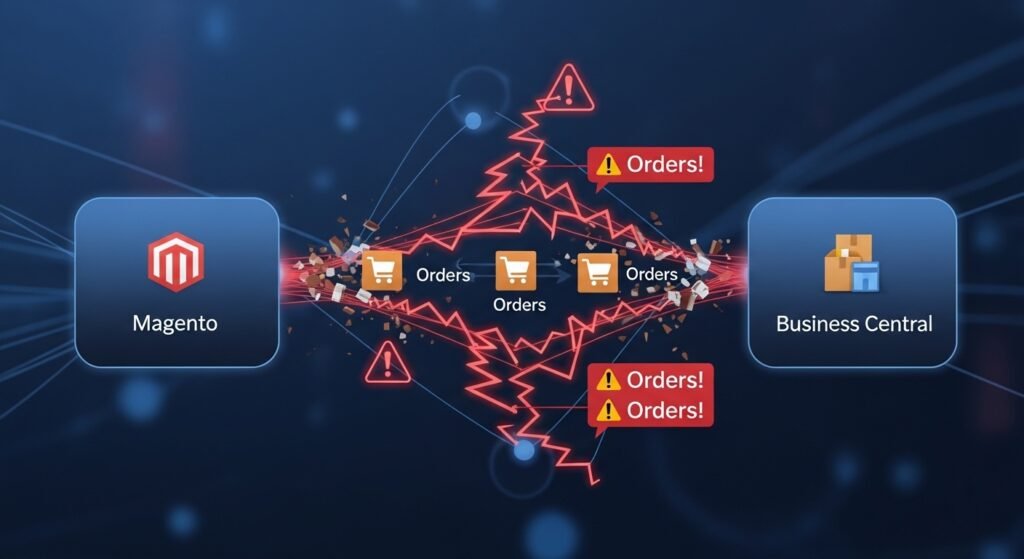
Duplicates usually come from retries. The connector sends an order, Business Central creates it, but the response times out on the way back. The connector assumes it failed and sends it again. Now there are two.
The standard protection is an idempotency check: before creating an order, the connector looks for an existing Business Central document that carries the Magento order number in a reference field, usually External Document No. If it finds one, it skips the create. Ask your integration partner whether yours does this. If it doesn’t, duplicates will keep appearing under load.
Partial orders, where some lines are missing, usually come from one bad line. A single unmapped SKU can stop the whole order or, worse, let it post without that line. I prefer setups that reject the whole order and log the reason, so nothing ships incomplete.
Inventory Sync Errors and Stock Mismatches

Inventory sync errors in Magento Business Central integrations can quickly lead to overselling, lost revenue, and frustrated customers. Inventory accuracy is especially critical for multi-channel and high-volume stores.
Incorrect Stock Levels in Magento
When numbers don’t match, start by checking what each system is actually measuring. Magento shows salable quantity, which subtracts open order reservations. Business Central shows inventory at a location, which only changes when a shipment or adjustment posts. A gap between the two is normal while orders are open. A gap that stays after orders ship is a real error.
The real errors usually come from:
- Unmapped locations. A Business Central location that holds stock but isn’t linked to a Magento source.
- Manual edits in Magento. Someone changes a quantity in the Magento admin, and the next sync overwrites it, or doesn’t.
- SKU mismatches. Trailing spaces, different cases, or old item numbers that were renamed in one system only.
- Stalled sync jobs. The stock job stopped and nobody noticed.
The rule that fixes most of this: Business Central owns stock. Magento displays it. Nobody edits quantities in Magento after go-live.
Overselling or Out-of-Stock Issues
Overselling happens when Magento allows a sale for stock that is already committed. The causes are timing gaps and channels Magento doesn’t know about, like phone orders, B2B orders entered in Business Central, or a second storefront.
To reduce it:
- Send available quantity, not just on-hand quantity. Available means on hand minus open sales orders already in Business Central.
- Use event-based updates for fast-moving items, so a posted shipment or a new sales order triggers a stock push.
- Keep Magento’s checkout reservations on, so two shoppers can’t buy the last unit at once.
- Set a small safety buffer on items that sell across several channels.
If you run more than one storefront, the same rules apply across all of them. That’s where a setup covering several Business Central eCommerce integrations helps, because Magento, WooCommerce and Shopify can all read stock from the same Business Central locations.
Product and Pricing Sync Issues
Product and pricing sync issues mean item details or prices in Magento don’t match Business Central. For B2B stores, wrong prices cause more customer complaints than any other sync problem.
Products Not Updating in Magento
When product changes in Business Central don’t reach Magento, the cause is usually one of these:
- The item isn’t flagged for web sync in Business Central
- A required Magento attribute has no mapped source field
- A custom attribute uses a type the connector doesn’t support, such as a multi-select with values that don’t exist in Magento
- The item’s category doesn’t exist in Magento yet
- Magento’s indexers are behind, so the change saved but doesn’t show on the storefront
That last one catches people often. The product data updated correctly, but the storefront still shows the old version. Check the index status in Magento before you blame the sync.
Incorrect Prices or Missing Discounts
Pricing errors almost always come from two systems both trying to be the source of prices. Someone sets a special price in Magento while Business Central holds a different price list. Whichever sync runs last wins.
My approach:
- Pick one owner. Business Central should hold base prices, customer price groups and line discounts.
- Sync the rules, not just the numbers. A B2B customer’s price comes from their customer group and quantity breaks. Sending one static price per product loses that.
- Map customer groups carefully. Each Business Central customer price group needs a matching Magento customer group.
- Test as real customers. Log in as a retail customer, a wholesale customer and a guest, and check the same product for each.
Customer and Account Sync Errors
Customer sync errors mean accounts are missing, duplicated or linked to the wrong record. They cause wrong pricing, failed orders and messy reporting.
Missing or Duplicate Customers
Duplicates happen when the connector can’t match a Magento customer to an existing Business Central customer. It creates a new one instead. The fix is a reliable unique key.
- For B2C: email address is usually the safest key.
- For B2B: use the Business Central customer number, stored on the Magento company or customer account.
- For guests: decide upfront whether guest orders go to one generic web customer or create individual records. Mixing both creates chaos.
If duplicates already exist, merge them in Business Central first, then update the mapping so the connector points to the surviving record. Merging without fixing the key just means new duplicates next week.
Address and Tax Data Errors
Address and tax errors stop orders from posting or post them with the wrong tax. Common causes:
- Country and region codes that differ between systems, such as full state names in Magento and two-letter codes in Business Central
- Address lines longer than Business Central’s field length, which get cut off or rejected
- Tax areas in Business Central that don’t match the tax rules in Magento
- Tax-exempt B2B customers whose exemption is set in one system only
Standardize country, state and tax codes before go-live. Then decide which system calculates tax on web orders. If Magento calculates it, Business Central should accept that amount. If both calculate independently, rounding differences will show up on invoices.
API, Performance, and Timeout Errors
API errors mean the connection itself fails, either because the connector can’t sign in or because Business Central refuses or delays the request. These errors stop everything at once, so they deserve monitoring of their own.
API Authentication Failures
Authentication failures usually start after a change nobody connected to the integration: a password reset, a disabled user, an expired client secret or a new security policy.
To prevent them:
- Run the integration under a dedicated service principal, not a person’s account
- Record when each client secret expires and rotate it before that date
- Alert on repeated authentication failures, not just on the first one
- Keep the integration user’s permissions limited to what the sync needs
Slow Sync or Timeouts
Business Central online limits how fast and how much any one user can call its APIs. According to Microsoft’s Business Central online operational limits, each user can make 6,000 OData requests in a sliding 5-minute window, with up to 5 requests running at the same time. Go over the rate and Business Central returns HTTP 429, Too Many Requests. An operation that runs longer than 8 minutes times out, and a single batch request can hold up to 100 operations.
That has real consequences during a big catalog update or a sale. A connector that pushes thousands of stock changes one call at a time will hit the limit and start failing. What helps:
- Batch requests. Group changes into batch calls instead of one request per record.
- Back off and retry. When Business Central returns 429, wait and retry with an increasing delay instead of hammering it.
- Send only changes. Sync records that changed since the last run, not the full catalog.
- Spread heavy work. Run full product syncs outside trading hours.
On the Magento side, much of the integration work runs through message queue consumers. Adobe’s guide to managing message queues explains that the consumers_runner cron job starts them, and by default each consumer processes 10,000 messages and then stops until cron starts it again. If Magento cron isn’t running, those consumers never start, and anything waiting in the queue just sits there. I always check cron early when a sync slows down for no obvious reason.
How to Monitor and Prevent Magento Business Central Sync Errors
The best way to handle Magento Business Central sync errors is to catch them within minutes, not days. A simple monitoring routine does most of the work.
Here is the routine I recommend:
- One central sync log. Every record that moves, with its status and error message, in one place you can filter.
- Alerts on failure. Business Central’s Set Up Job Queue Notifications guide can notify you when a job queue entry fails, including through a Power Automate flow. Use it.
- A daily health check. Count orders placed in Magento versus orders created in Business Central for the same day. They should match.
- A weekly stock audit. Compare stock for your 20 fastest-moving items in both systems.
- Retest after every update. Business Central and Magento both update regularly. After either one updates, place a test order and run a stock sync before trusting it again.
- Document the mapping. Keep a simple sheet of every mapped field, location, customer group and payment method. When something breaks, you’ll know what changed.
Prevention is cheaper than cleanup. One failed order caught in five minutes is a retry. The same failure found after a week is a customer service problem.
When to Use a Custom Magento Business Central Integration
A custom or deeply configurable integration makes sense when a generic connector keeps forcing workarounds. Generic tools handle standard orders, products and stock well. They struggle with anything that doesn’t fit their template.
You likely need more than a generic connector if you have:
- B2B pricing with customer-specific price lists and quantity breaks
- Several Magento websites or store views tied to one or more Business Central companies
- Several warehouses that must each map to a Magento source
- High order volume that pushes against API limits
- Custom Business Central fields or processes that must reach Magento
If you are comparing platforms before you commit, the breakdown of Magento vs WooCommerce for Business Central ERP shows where each storefront fits. And if you want to see what a purpose-built option covers, the overview of why you need Business Central Magento integration lists the orders, inventory, pricing, shipment and invoice flows it handles. Budget usually decides the rest, so the published Business Central Magento connector pricing is worth checking against the cost of a custom build.
Frequently Asked Questions
Why are my Magento orders not syncing to Business Central?
The most common causes are expired API credentials, a Business Central job queue entry stuck in Error or On Hold, and order fields that don’t map, such as an unknown SKU, shipping method or payment method. Check authentication first, then the job queue log, then one failed order field by field.
How do I stop duplicate orders between Magento and Business Central?
Duplicates come from retries after a timeout. The fix is an idempotency check: store the Magento order number in a Business Central reference field, such as External Document No., and have the connector check for it before creating an order. Never re-enter failed orders by hand.
Why doesn’t Magento stock match Business Central?
A temporary gap is normal because Magento subtracts open order reservations and Business Central only changes stock when shipments post. A lasting gap usually means an unmapped location, a SKU mismatch, a stalled sync job, or someone editing quantities in Magento. Make Business Central the only system that changes stock.
What does a 429 error mean in a Business Central integration?
HTTP 429 means Too Many Requests. Business Central online limits each user to 6,000 OData requests in a 5-minute sliding window and 5 concurrent requests. The connector should batch changes, sync only what changed, and retry with an increasing delay when it receives a 429.
Should Magento or Business Central own prices?
Business Central should own base prices, customer price groups and discounts, and Magento should display them. When both systems can edit prices, whichever sync runs last wins, which causes wrong prices for B2B customers. Map each Business Central price group to a Magento customer group and test as each customer type.
How can I catch sync errors before customers notice?
Keep one central sync log, turn on job queue failure notifications in Business Central, and compare daily order counts between Magento and Business Central. Add a weekly stock check on your fastest-selling items and retest after every update to either system.
Final Thoughts
Magento Business Central sync errors are almost never random. They come from mapping gaps, missing unique IDs, timing conflicts and API limits, and each one has a clear fix. Give every data type one owner and one direction, watch the job queue and message queues, and catch failures within minutes.
Do that, and the integration fades into the background where it belongs. If you’d rather have a team set it up and watch it for you, our Business Central Magento connector was built for exactly these flows, and you can contact us to talk through your setup.

Pingback: Why You Need Business Central Magento Integration by New Wiz Tech